Industry
Healthcare Education / Maternal Health Education
Headquarters
Chicago, Illinois, USA
Company Size
51–200 Employees
The Baby Academy’s work is all about helping expectant and new parents feel informed, confident and supported. Behind that public-facing experience, however, the team also has to exchange sensitive referral, enrollment, eligibility and billing data with a growing number of healthcare organizations.
As those relationships expanded, so did the operational challenge. Different systems, schedules and file requirements made the process harder to manage consistently, particularly while much of the work still depended on manual handling.
We chatted with Brian Kindle, Vice President, Global Head of Marketing at The Baby Academy, about why the company chose SFTP To Go and how it brought greater control and visibility to those exchanges without adding its own SFTP infrastructure.
Background
Founded in Dublin, Ireland, in 2019 and now headquartered in Chicago, The Baby Academy is a digital healthcare education company that provides live, expert-led online classes for expectant and new parents.
Its classes help families feel informed and supported through pregnancy, birth and early parenthood. The company serves parents across the United States, Canada, the United Kingdom and Ireland, with sessions delivered by experienced healthcare and educational professionals.
The Baby Academy also works with health insurers and maternal-health organizations to make evidence-based education available to more families. Those relationships bring a practical data-exchange challenge.
While the classes are the visible part of that work, these programs also depend on a steady flow of registration, referral, eligibility, attendance and billing information. Managing that flow had become an increasingly demanding part of the company’s day-to-day operations.
The challenge
Before rolling out SFTP To Go, The Baby Academy relied on a mixture of manual processes to exchange data.
As Brian explained:
We work with healthcare and maternal-health partners that have different systems, data formats and security requirements. Our team must reliably exchange sensitive customer information while maintaining strong privacy and HIPAA-compliant processes.

The files can contain class registration and attendance records, healthcare referrals, insurance eligibility details, enrollment information, billing data, and personal and protected health information. The challenge was to handle that varied and sensitive information reliably without creating a separate process for every organization.
What’s more, the team had to accommodate partner organizations with different file formats, organization-specific naming conventions, separate delivery schedules, varying technical specifications, unique data compliance requirements, and different levels of technical capability.
As the company’s network grew, these methods became harder to manage consistently. The Baby Academy wanted to avoid creating a separate transfer operation for every new relationship and reduce the risk of files being overlooked, transferred incorrectly or left without a clear delivery record.
Building an internal SFTP environment would have added another system to host, secure, monitor and maintain. The team also needed a process that operational staff could manage without relying on engineering support for routine changes.
The main requirements were:
- Encryption during transfer and storage
- Dedicated credentials and access controls for each organization
- HIPAA file transfer controls
- Healthcare SFTP automation
- Activity records and notifications
- Confirmation that files had been delivered or received
- Flexibility for different technical requirements
- Capacity for more connections and larger data volumes
- Managed file transfer without internal server maintenance
The SFTP To Go solution
The Baby Academy chose SFTP To Go to bring these exchanges into one secure, managed service. It now uses the platform to exchange scheduled files between its internal systems and selected healthcare organizations.
Each organization can be assigned dedicated credentials and access to only the files it needs. This keeps data separated while giving The Baby Academy a single place to manage transfers, review activity and confirm delivery.
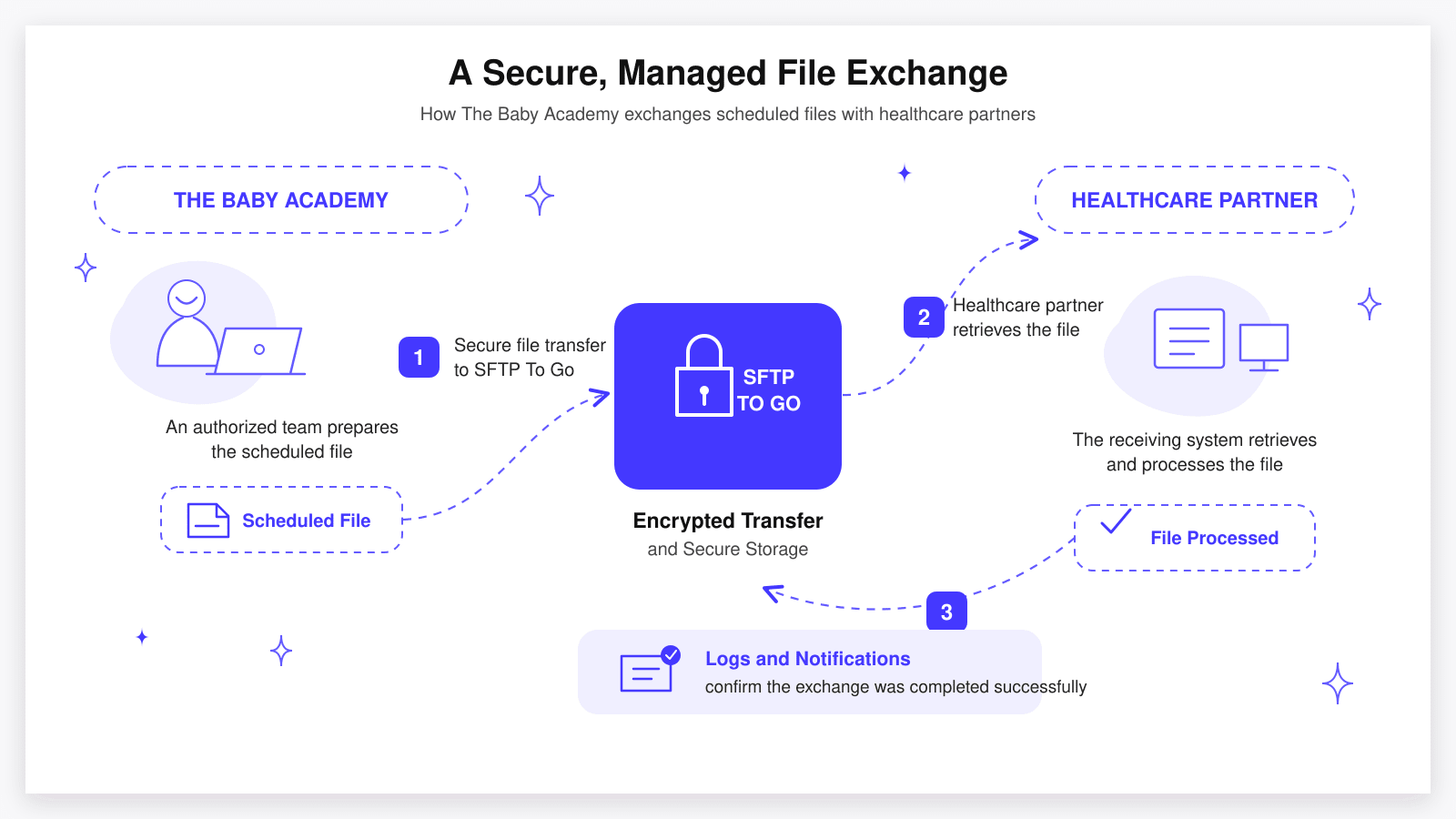
The process looks like this:
- An authorized team prepares the scheduled file.
- The file is sent through the relevant secure connection.
- SFTP To Go encrypts the transfer and stores the file securely.
- The receiving system retrieves and processes it.
- Logs and notifications confirm whether the exchange was completed successfully.
Brian shared that:
Each partner could be given dedicated credentials and access controls, while scheduled transfers, activity logs and notifications helped our team manage and monitor the process.
Although file formats, schedules and technical requirements still vary, The Baby Academy can configure each new connection within its existing SFTP To Go environment instead of creating a separate transfer process.
For Brian, the main value is consistency: the company can accommodate different healthcare data requirements while keeping administration straightforward.
How SFTP To Go supports HIPAA controls
Some of the information exchanged through these processes may include personal information or protected health information (PHI). The transfer service therefore had to provide more than an encrypted connection; it also needed to support the broader controls required by HIPAA.
Relevant SFTP To Go capabilities include:
- Encryption: SFTP To Go supports SFTP, FTPS and HTTPS transfers, while files in its built-in Amazon S3 storage are encrypted at rest. These controls contribute to HIPAA-compliant cloud storage.
- Access management: Separate credentials, home-directory restrictions and folder permissions can limit each user or organization to authorized files.
- Authentication: Automated SFTP connections can use SSH keys. Organizations using the web portal can also enable mandatory MFA for portal credentials.
- Auditability: Activity logs record admin events, access and file events. Audit data can be exported and stored long term, while eligible plans support SIEM log streaming for centralized monitoring.
- Webhook notifications: Allow for real-time alerts and monitoring on access, file and administration events.
- Administrative oversight: Logs can include administrative events as well as file activity, giving security teams visibility into configuration and account changes.
- Business associate arrangements: A Business Associate Agreement is available where required.
A managed file-transfer service like SFTP To Go can address several items on your HIPAA compliance checklist, but it can’t make an organization compliant by itself. HIPAA compliance also depends on policies, workforce practices, contractual agreements, risk analysis, system configuration and healthcare data governance. SFTP To Go contributes controls specifically related to file transfer, access and storage.
Key benefits
SFTP To Go has simplified how The Baby Academy manages recurring data exchanges.
The company now benefits from:
- One managed environment: Each organization receives separate credentials, folder access and permissions without requiring its own transfer system.
- Less manual work: Recurring exchanges, activity logs and file-event notifications reduce repetitive handling and follow-up checks.
- Clearer oversight: Staff can review transfer activity and verify whether expected files were uploaded or retrieved.
- Quicker onboarding: New connections can be configured without deploying additional infrastructure.
- No server maintenance: The team doesn’t have to host, patch, secure or administer an internal SFTP server.
- Capacity to grow: The existing environment can support additional connections and increasing data volumes.
- Straightforward administration: Operational and technical staff can oversee routine exchanges without substantial ongoing IT support.
This gives the team a clearer, more scalable process for handling sensitive healthcare data.
Why they chose SFTP To Go: Advice for similar businesses
Brian said the decision came down to four things: reputation, price, flexibility and the support The Baby Academy received early on.
The team wasn’t looking to take on another technical project or maintain its own transfer infrastructure. It needed a service it could get running quickly, shape around different healthcare requirements and manage without making routine file exchange harder than it needed to be.
That’s relevant well beyond hospitals and clinical systems. Companies working in digital health and healthcare education may still handle referral, eligibility, enrollment and billing records that need restricted access, dependable delivery and a clear audit trail.
When we asked what he’d tell others facing the same problem, Brian’s advice was to:
Look for a solution that combines strong security and compliance with ease of implementation and day-to-day management. SFTP To Go helped us establish dependable data exchanges without adding unnecessary infrastructure or operational complexity, allowing our team to focus on serving our customers and growing our partner network.
Conclusion
SFTP To Go has given The Baby Academy one managed service for exchanging sensitive information with healthcare and maternal-health organizations. The company can add new connections without rebuilding its transfer process each time, while retaining the separation and visibility required for healthcare data.
Dedicated access, scheduled transfers, activity records and notifications make these exchanges easier to oversee.
That leaves The Baby Academy’s team with more time to focus on helping parents feel informed, prepared and supported. Learn more about The Baby Academy, or start a free SFTP To Go trial to explore secure managed file transfer and storage for healthcare data.